

A cold chain is only as good as its weakest hand-off. The cold store may hold 3 °C all week, but if the pallet waits forty minutes on a dock at 38 °C, or the reefer is set to the wrong range for the last leg, the product arrives compromised and nobody can say where it happened. Cold chain monitoring puts a continuous temperature record on every stage, so the question "where did it warm up?" has an answer instead of an argument. It is one application of the temperature and humidity monitoring systems HHET installs across Saudi Arabia; this page covers what is specific to a chain that moves.
Where the cold chain actually breaks
Ask a quality manager at a Saudi food or pharmaceutical distributor where excursions occur and the answer is rarely "inside the cold room". Rooms are engineered, alarmed and watched. Excursions happen in the gaps between them: the staging area where picked orders wait for the truck, the dock where doors stay open while a driver finds paperwork, the first thirty minutes of a journey before the reefer pulls the body down to set-point, the kerbside outside a pharmacy while the receiving staff finish with a customer. In summer, when ambient temperatures in Jeddah, Riyadh and the Eastern Province commonly exceed 40 °C, each of those gaps is measured in minutes, not hours. A cold chain monitoring system is designed around those gaps. It assumes the rooms are fine and concentrates on proving what happened in between.
The stages of a cold chain and what is monitored at each
The table shows a typical chilled or frozen distribution chain in the Kingdom and the signals HHET records at each stage. Pharmaceutical chains add mapping and calibration records; food chains add HACCP critical control points at receiving and dispatch.
| Stage | What is monitored | Sensor or device | Who sees the alert |
|---|---|---|---|
| Supplier or central cold store | Room temperature and humidity, door state, power | Fixed wireless sensors, door contacts | Warehouse supervisor |
| Picking and staging | Product temperature while orders wait; dwell time | Zone sensors in the staging area, timed dwell alerts | Dispatch lead |
| Loading dock | Dock temperature, door-open duration, pre-cooling of the truck body | Dock zone sensor, reefer body probe, door contact | Dispatch lead, driver |
| In transit | Cargo temperature against set-point, door openings, position and route | GPS unit with reefer probes and door sensor | Dispatcher, quality team |
| Cross-dock or hub | Dwell time and temperature during transfer | Portable data logger travelling with the pallet; hub sensors | Hub supervisor |
| Customer receiving | Temperature at hand-over, time of delivery | Logger read-out or platform report; GPS arrival time | Customer, account manager |
The storage leg: cold rooms and warehouses
Fixed monitoring at origin and destination is the easy part, and it is where the record starts. Each chiller, freezer and ambient zone carries sensors that report to the HHET platform, with limits set per product class and alarms that escalate when a reading stays out of range beyond a set delay. The specifics of probe placement, door events and night-time alarms are on the cold room temperature monitoring page. What matters for the chain is that the storage record and the transport record live in the same platform, against the same product and the same date, so a pallet's history reads as one line rather than three spreadsheets from three departments.
The transport leg: reefer trucks on the same map
Transport is where HHET's two product lines combine. The same unit that provides GPS tracking for trucks can read probes in the refrigerated body and report cargo temperature, set-point, door state and position every few minutes. A dispatcher sees a truck that is behind schedule and a body that is three degrees warm on the same screen, and can call the driver before the delivery is refused. The full set of signals, excursion rules and per-delivery reports are described on the refrigerated truck monitoring page. For fleets that are not yet tracked, that page also covers how the monitoring unit is fitted alongside, or as part of, the tracking installation.
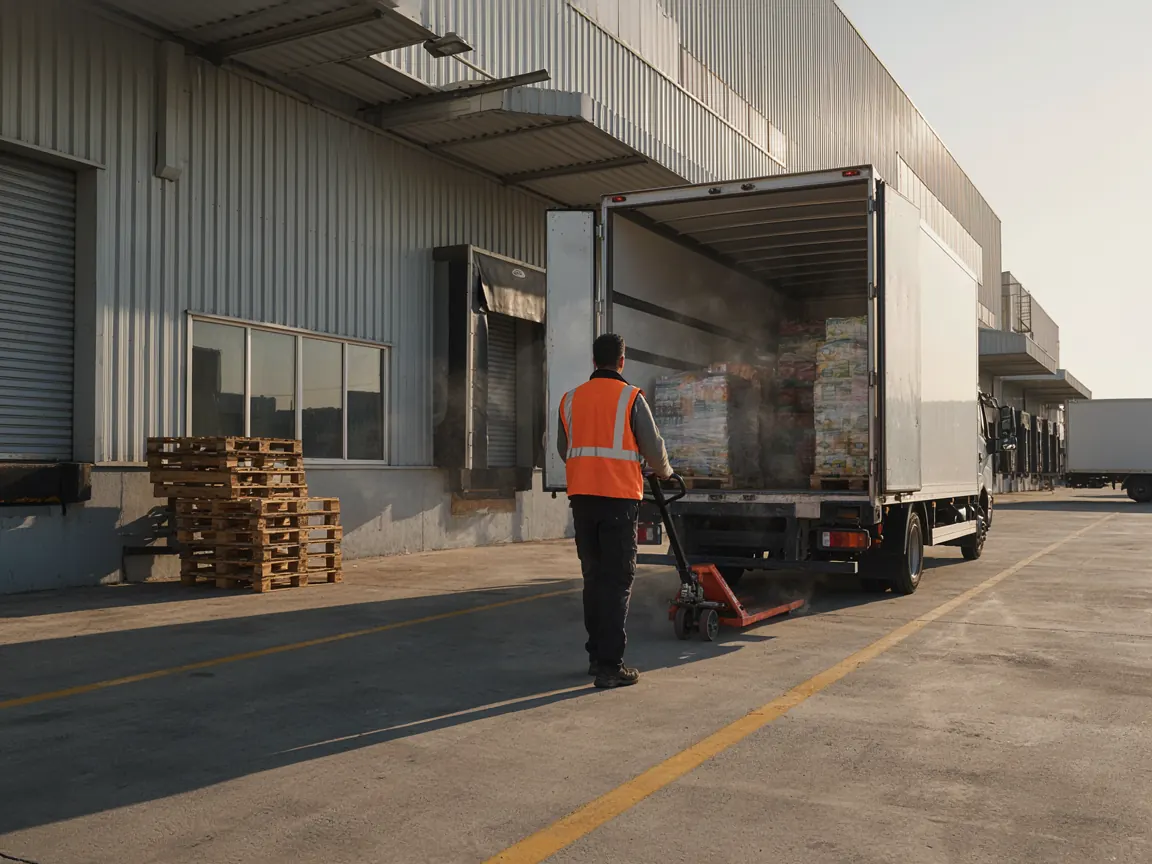
Hand-offs: docks, cross-docks and receiving
Hand-offs are where ownership changes and records usually stop. HHET closes them in two ways. Where a site is yours, zone sensors and door contacts at the dock record how long product waited and at what temperature, and a timed dwell alert tells the dispatch lead when a staged order has been out of the cold room too long. Where the site is not yours, a portable temperature and humidity data logger travels inside the pallet or tote and records the whole journey independently of the vehicle, so the customer's receiving record and your dispatch record agree. The guide to what a data logger is and how to choose one explains standalone and connected types. For medicines, the SFDA expects these hand-offs to be documented; see SFDA-compliant temperature monitoring for how transport records fit the wider requirement.
Excursions: what happens when a link fails
An excursion is any period during which product temperature leaves its allowed range. A monitoring system cannot prevent all of them, but it changes what happens next. The alert reaches someone while the product is still recoverable: a driver can be told to check the reefer, a dock door can be closed, a pallet can be moved back into the room. The record shows the duration and magnitude, which is what a pharmacist or quality assessor needs in order to decide whether the product can be released, quarantined or destroyed. And the pattern, over weeks, shows which route, which dock or which driver produces excursions, so the cause can be fixed rather than the symptom reported. HHET configures excursion alerts with a delay appropriate to the product, so a brief door opening at a delivery does not generate an alarm but a reefer failure does.
Agree the excursion rules with your customers before the first shipment: the range, how long outside it counts as an excursion, and who assesses the product. When both sides read the same HHET report against the same rules, a disputed delivery becomes a five-minute conversation.
Proof for customers, auditors and the SFDA
The output of cold chain monitoring is a report a customer will accept without a phone call. The HHET platform produces a per-shipment record showing origin temperature, loading time, the in-transit trend, door openings, arrival time and hand-over temperature, exportable as PDF for the delivery file or shared as a link. Over a month, the same data becomes a route-and-site review for the quality team. Price depends on the number of fixed sensors, the number of vehicles fitted, whether portable loggers are needed for third-party legs, and the calibration and documentation your products require. To scope a cold chain monitoring system for your network, request a quote and describe your stores, vehicles and the products you move.
Cold chains look different by sector: see pharmaceutical distribution and food distribution for transport-specific setups, and wireless IoT monitoring for how sensors scale from one room to many sites.
Last reviewed .