
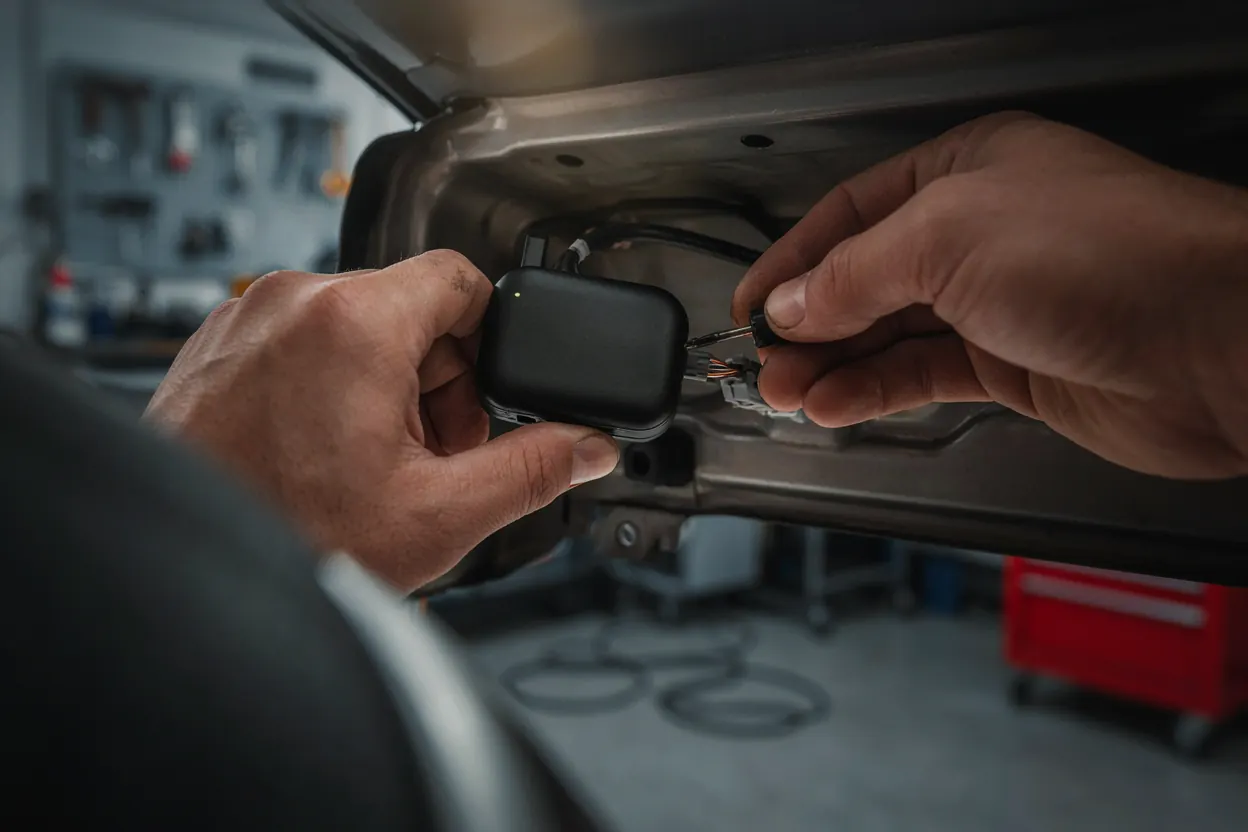
An IoT temperature monitoring system replaces the clipboard round and the stand-alone logger with small battery sensors that report readings over radio to a platform, where they are stored, trended and checked against limits around the clock. It is the sensor layer of HHET's wider temperature and humidity monitoring system, and the part that decides how quickly a site can be covered, because wireless sensors need no cable run through a cold-room wall, a pharmacy ceiling or a warehouse roof. This page explains how the readings travel, how LoRa, cellular and Wi-Fi sensors differ, what governs battery life and coverage, and how a system grows from one room to many sites.
How wireless monitoring works
Every wireless installation has the same four links. A sensor measures temperature, and where needed humidity, at a set interval. A radio sends that reading either straight to the internet or to a gateway that is. The HHET platform stores each reading with its time and the sensor's identity, and a rules engine compares it with the limits set for that location. Finally, a notification path carries any breach to a named person by app, SMS or call, and escalates if nobody acknowledges it.
The detail that matters is what happens when a link fails. A well-built sensor keeps measuring and holds readings in memory if the radio or the network is down, then sends the backlog when the link returns, so the record has no hole. A gateway with a battery and its own cellular uplink keeps a site visible through a power cut in the building, which is usually the very moment you want to know about. A data logger is the simpler cousin of this arrangement: it records faithfully but tells nobody until someone downloads it. The wireless system adds the real time temperature monitoring system behaviour on top: the number is on a screen within a reporting interval, and the alarm does not wait for a visit.
LoRa, cellular and Wi-Fi sensors
There is no single best radio. Each suits a different building, and a mixed system is common. The table sets out how HHET typically chooses between them.
| Radio | How it connects | Suits | Watch for |
|---|---|---|---|
| LoRa (low-power long range) | Sensor talks to a nearby gateway; the gateway uplinks over Ethernet or cellular | Many sensors in one building or yard: warehouses, cold-room blocks, pharmacy chains' back stores | Needs a gateway; thick metal and concrete shorten range, so placement is surveyed |
| Cellular (LTE-M, NB-IoT or 4G, depending on coverage) | Sensor reports directly to the network, no gateway | Single sensors at remote or unmanned points: a farm cold store, a site container, a standalone freezer | SIM and data plan per sensor; indoor signal inside insulated rooms must be tested |
| Wi-Fi (2.4 GHz) | Sensor joins the site's own Wi-Fi network | Offices, labs and server rooms with managed Wi-Fi and mains power nearby | Depends on your network and password changes; Wi-Fi drops with the building's power |
| Wired probe on a wireless head | A probe cable runs into the cold space, the radio unit stays outside | Insulated rooms and freezers where a radio inside would be shielded or frozen | Probe cable passes through a door gasket or a sealed port |
For a hospital or lab with a managed network, Wi-Fi sensors are often the quickest route. For a warehouse with dozens of measurement points, LoRa keeps running costs low, because only the gateway needs a data connection. For a single remote freezer, a cellular sensor avoids any site infrastructure at all. HHET surveys the site before choosing, and mixes radios where one site calls for it, since all of them feed the same platform and the same alarm rules.
Battery life and coverage
Battery life is mostly a function of how often the sensor wakes and transmits. A sensor that reports every fifteen minutes lasts far longer than one that reports every minute, and a sensor in a freezer loses capacity faster than one at room temperature, because cold cells deliver less. HHET therefore sets the reporting interval from the risk, not from habit: a vaccine fridge or reefer cargo justifies a short interval, while a dry store can report slowly. Many sensors also report more often once a reading nears its limit, so the battery is spent where the information is. Typical life with common batteries is measured in many months to a few years, depending on the interval and the environment, and the platform shows each sensor's battery level so replacement is scheduled rather than discovered.
Coverage deserves the same discipline. Radio range quoted in open country says little about a cold room with steel-skinned insulated panels. A site visit, or a trial with a gateway in the planned position, shows which sensors reach and which need a repeater or a different spot. The sensors for steel-lined rooms are often best placed with the radio outside the panel and a short probe inside; the guide to humidity and temperature sensors covers probe types, accuracy and calibration.
Test the worst location first. If the sensor in the deepest corner of the freezer, behind stacked pallets, reports cleanly, the rest of the site will too. Start the survey there, not at the door next to the gateway.

Alerts that reach someone
A wireless system is only as useful as its alert path. HHET configures thresholds per location and a delay so a door opened for stock-taking does not page anyone at midnight, but a compressor failure does. Alerts go to the on-duty person first, by app and SMS, with the location, the reading and the trend. If it is not acknowledged within a set time, it moves to the next person on the chain, and where the activity needs it, to a voice call. Every alert, acknowledgement and action is logged. The same record that proves a response also feeds the audit file, which is why cold room monitoring and the other temperature pages treat the log as the product, not the sensor.
Scaling from one room to many sites
Most customers begin with the place that hurts: one walk-in room, one pharmacy fridge, one truck. Wireless makes the next step inexpensive, because adding a point is a sensor, not a cable job. The platform scales in three directions. More points per site means more sensors on the same gateway. More sites means a new gateway or cellular sensors reporting into the same account, so a head office in Jeddah sees branches in Riyadh and Dammam on one dashboard with per-site permissions. More use cases means the same platform also carries vehicles: refrigerated trucks report cargo temperature through the tracker described under refrigerated truck monitoring, and the delivery record joins the storage record in one cold chain.
Two practices keep growth manageable. Name every sensor by what it protects, such as "Branch 4 / Vaccine fridge 2", not by serial number. And agree who owns each alarm before the second site goes live, so escalation chains stay short as the estate grows.
Where your activity requires monitoring records, for example pharmaceutical storage under SFDA expectations, regulators and auditors typically look for continuous readings, calibrated sensors and a retained alarm history. A wireless system can supply these, but HHET confirms the current requirement for your licence before specifying devices, and does not describe any sensor as SFDA approved unless that is true.
Pricing and next step
Price depends on the number of measurement points, the radio types, whether gateways are needed, calibration certificates, the reporting interval and the monitoring subscription. HHET quotes after a short survey of the site, because the building decides the radio choice more than any datasheet does. To start, request a quote with the number of rooms or sites, the products stored and the limits you work to. If you are comparing options, the guide on how to choose a data logger sets out when a logger is enough and when a live system earns its place.
The same wireless sensors suit IT rooms too: the server room monitoring page covers temperature, humidity, water and door sensors for equipment rooms.
Last reviewed .