
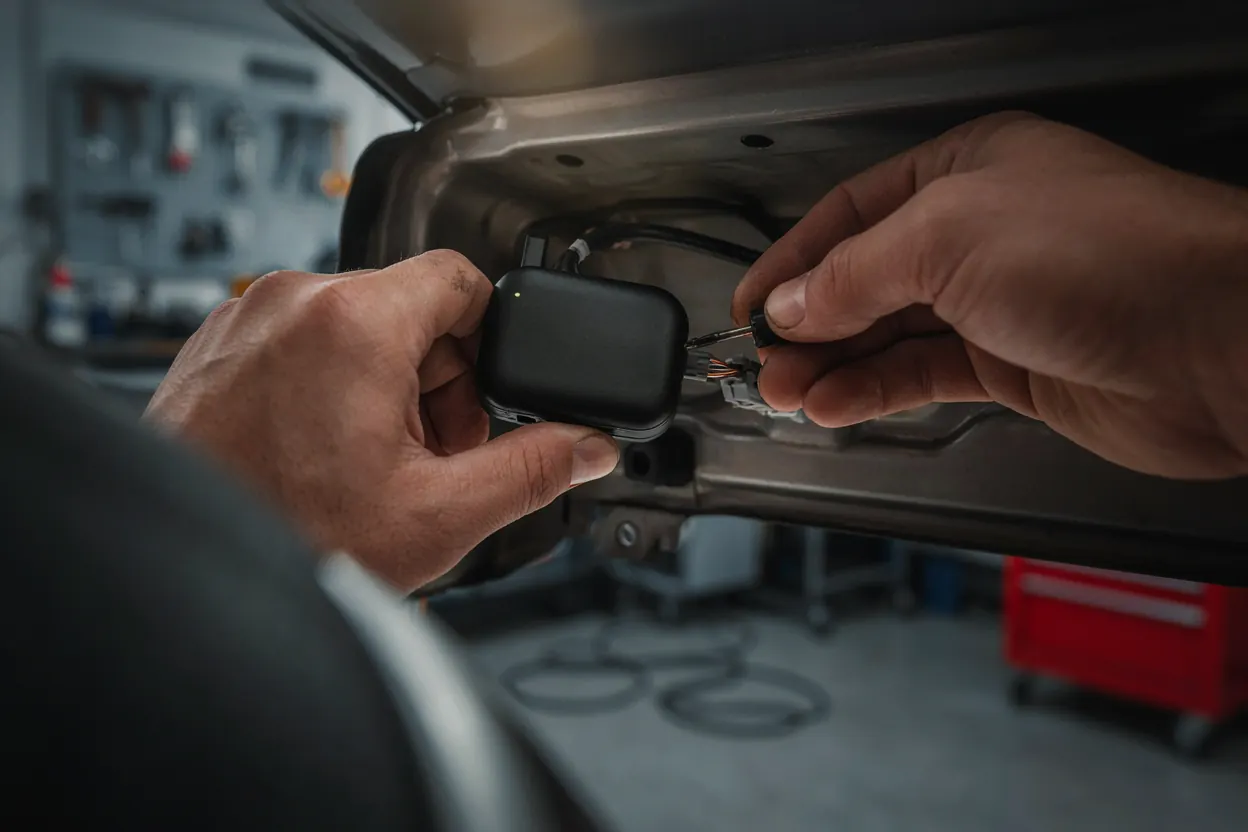
Fitting a car GPS tracker is not difficult, but it is unforgiving. A loose ignition feed, an antenna buried under metal, or a relay wired into the wrong supply gives you a device that reports late, flattens the battery, or cannot be trusted on the day it matters. HHET's installation service puts a trained technician on the vehicle, tests every function before the vehicle is handed back, and leaves the device live on your account. This page explains what that involves, where we do it and how long it takes. If you have not yet chosen the device, our guide to car GPS trackers and tracking devices compares the types first.
What a professional installation involves
A standard wired install follows the same sequence whether the vehicle is a saloon, a pickup or a 24 V truck. The order matters: power and signal first, then placement, then everything that depends on the device being alive.
- Vehicle check and placement plan. The technician confirms the vehicle's voltage, locates a permanent feed, a ground point and a true ignition signal from the wiring diagram, and chooses a mounting position that is out of sight, away from heat and moving parts, and reachable for service.
- Power and ground. The device is connected to a constant supply through an inline fuse and to a clean chassis ground. On modern vehicles many lines are switched off by the body computer when the car sleeps, so the technician verifies that the feed stays live with the vehicle locked.
- Ignition signal. A line that goes live only when the ignition is on. This is what turns raw positions into trips with a start, an end and an idle time, and it is the connection most often done wrong in self-installs.
- Antenna placement. Internal antennas are positioned facing upward with no metal above them; where the device must sit low, an external antenna is routed to the base of the windscreen or under a plastic trim. Windscreens with a metallic tint or heating film are checked, because they can weaken the signal.
- Relay for engine cut-off, where ordered. A relay is wired into the starter or fuel-pump supply so the platform can prevent a restart. The relay is tested in both states and the cut-off logic is set so it acts only when the vehicle is stationary. Our page on anti-theft tracking with engine cut-off explains that logic.
- Sensors and accessories. Fuel sensors, temperature probes, door contacts, driver ID readers and cameras are fitted, and each one is checked against a live reading on the platform.
- Testing. With everything connected and the panels still off, the technician confirms a satellite fix, a network connection, correct ignition-on and ignition-off events, the battery voltage reading, backup battery operation and, if fitted, the relay. Only then are the trims refitted.
- Activation on the HHET platform. The device is added to your account under the vehicle's plate and description, its reporting profile is set, and the user's app login is confirmed by watching the vehicle move on the live map.
- WASL linking, where required. For vehicles in licensed transport activities, the approved device is linked on the Transport General Authority (TGA) WASL platform with the vehicle and operator details, and we confirm the link is reporting before we close the job. See TGA-approved tracking and WASL integration for which activities are covered.
Where we install: your site or our Jeddah workshop
Our technicians work from our base in Jeddah and install both at our workshop and at your premises. For a single car or a few, bringing the vehicle to us is usually fastest. For fleets, a site visit lets us work through vehicles in sequence without taking any of them off the road for long, and we can schedule around shifts, including early mornings before dispatch. Yards in Al Khumrah, the industrial city phases, the port area and Obhur are routine for us; there is more on our GPS tracking services in Jeddah page.
Outside Jeddah, we install across the Kingdom by arrangement. Makkah, Taif and King Abdullah Economic City are within a day's reach of the team; for Riyadh, Dammam and other regions we typically schedule visits around batches of vehicles so that travel does not inflate the cost. Tell us where the vehicles are parked and we will propose the most practical arrangement.

How long an installation takes
A standard wired tracker on a car or light van is usually completed in under an hour, including testing and activation. An OBD plug-in takes minutes. Add-ons extend the job: a cut-off relay adds a modest amount of time; a fuel sensor on a truck can take considerably longer, because the tank must be accessed and the sensor calibrated against known fuel levels; a multi-camera installation is closer to a half-day. Trucks and buses take longer than cars because of their size and 24 V systems. For fleet visits we plan the day around these figures and tell you in advance how many vehicles we expect to complete.
Installation types by device
| Device | Connections | Where it is mounted | Typical time | Who should fit it |
|---|---|---|---|---|
| Wired tracker (12 V or 24 V) | Permanent power, ground, ignition; optional relay and sensors | Behind the dashboard, under trim, or in the cab | Usually under an hour; longer with add-ons | HHET technician |
| OBD plug-in tracker | OBD port only | Under the steering column, or on an extension cable tucked out of the way | Minutes | Owner or technician |
| Magnetic / battery tracker | None | Trailer chassis, container, equipment, underside of a vehicle | Minutes | Owner or technician |
| Motorcycle tracker | 12 V supply and ground, waterproofed | Under the seat or fairing | Under an hour in most cases | HHET technician |
| Truck tracker with fuel sensor | Permanent power, ground, ignition, tank sensor | Cab plus fuel tank | Several hours including calibration | HHET technician |
The OBD option deserves a word. It is the quickest route to tracking a car and it reads engine data a wired unit cannot, but it sits in plain view and can be unplugged. For a pool car or a private vehicle it is a sound choice; for a rental or any vehicle that must not go dark, a wired unit is the better fit. Our page on OBD GPS trackers covers compatibility.
What we need from you
- The vehicle, with access to the cabin and, for trucks with fuel sensing, the tank area.
- The vehicle registration details, which we use to name the vehicle on the platform and, for regulated vehicles, to complete WASL linking.
- The name and mobile number of each person who will use the HHET app, so logins are ready before the technician leaves.
- For a cut-off relay, written confirmation of who is authorised to trigger it.
- For a site visit, a covered or shaded space where possible. Jeddah's summer heat is hard on technicians and on adhesive mounts alike.
After the installation
Before leaving, the technician shows the vehicle live in the app, walks through the alert settings that were agreed, and records the device serial, SIM and mounting location against the vehicle in our system, so later service does not start with a search. If a device later stops reporting, our platform support team checks its last contact, signal and power remotely before a visit is booked; most cases turn out to be a vehicle parked without signal or a battery disconnected during repair, not a fault.
If you are weighing professional fitting against doing it yourself, read our guide to installing a GPS tracker in a car and the companion piece on where to place a GPS tracker in a car. When you are ready, request a quote with the number and type of vehicles and where they are parked, and we will propose a schedule.
Last reviewed .