
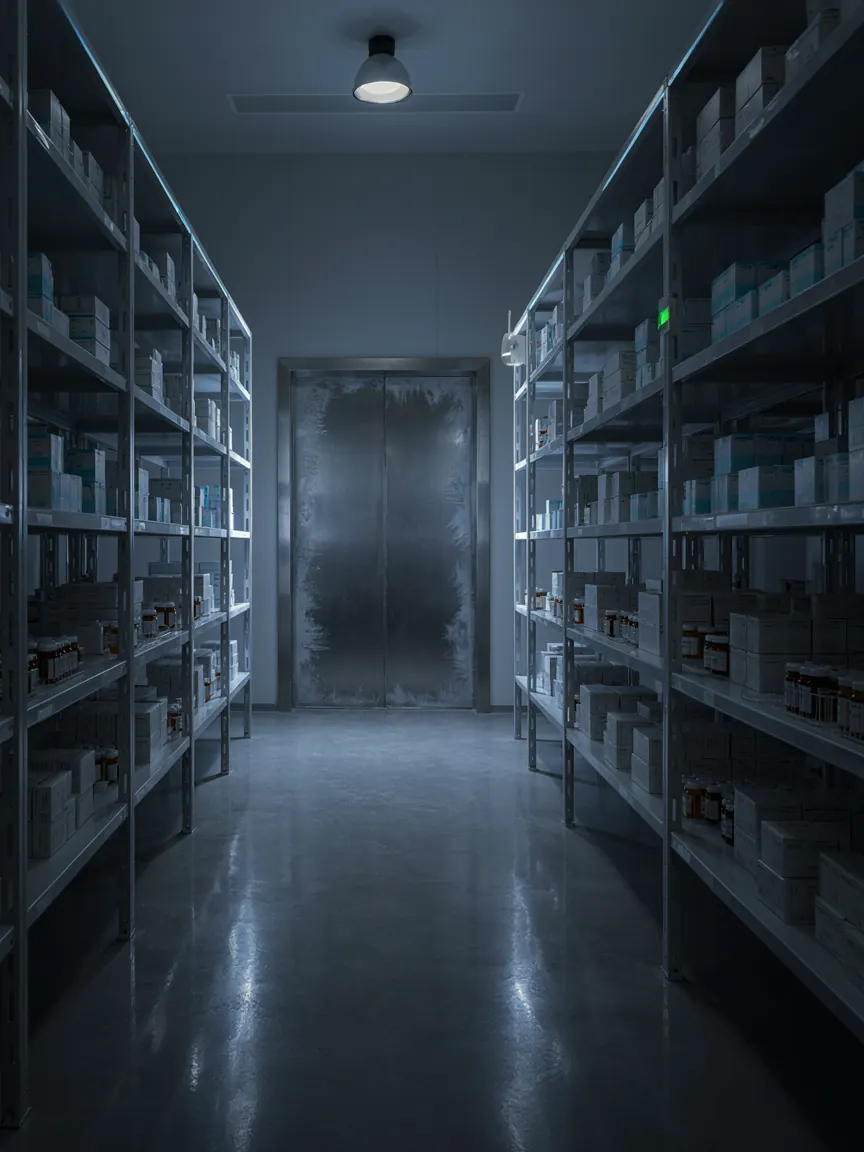
A hospital does not have one cold chain; it has dozens of small ones, each with a different owner: the blood bank, the pharmacy, the microbiology lab, the ward medication fridge, the research freezer. This page covers how HHET sets up temperature and humidity monitoring across those units so that one platform shows all of them and the right person is woken when one fails.
Blood banks, labs and hospital fridges
The units differ in what is at stake and so in how tightly they are watched. Red blood cells are typically stored at 2 to 6 °C, plasma frozen far below that, and platelets at room temperature on agitators; reagents and samples have their own ranges set by the manufacturer or the lab's procedure. The monitoring system does not decide those ranges. Your lab director or pharmacist does, and each sensor is configured with that unit's limits, not a one-size default.
Ward medication fridges are the quiet risk. They are opened by many people, often by someone in a hurry, and sit outside any one department's attention. A door-open sensor plus a probe in a buffered holder shows both the temperature and the cause when it moves.
| Unit | Typical concern | What HHET fits |
|---|---|---|
| Blood bank fridge | Narrow range, high consequence | Probe in glycol holder, door sensor, tight alert limits |
| Laboratory reagent fridge | Frequent door openings, shared access | Probe plus delay-tuned alerts |
| Ultra-low freezer (about -80 °C) | Compressor failure, door seal, frost | Low-temperature probe rated for the range, power-loss alert |
| Incubator | Temperature and sometimes CO2 or humidity | Temperature and humidity sensor inside or at the chamber |
| Lab room / store | Ambient temperature and humidity drift | Room sensor at working height, away from vents |
Sensors for -80 °C freezers and incubators
Ordinary sensors are not built for ultra-low temperatures. Batteries lose capacity in the cold, cables become brittle and some probes go out of specification. For freezers in the region of -80 °C, HHET specifies low-temperature probes rated for that range, with the electronics kept outside the freezer and a thin probe lead passed through the door gasket or an access port so the seal is not compromised. The sensor reads continuously while the radio unit sits at room temperature where its battery behaves normally.
Incubators bring the opposite constraint. The chamber is warm, humid and often has its own display, which may be accurate or may not. An independent sensor placed at the working position gives a second opinion, and a sudden gap between the incubator's display and the independent reading is itself an early warning. For humidity in the chamber, the sensor must tolerate condensation; ask for a type suited to high humidity rather than a general room sensor. The range of probe and sensor types is explained under temperature and humidity sensors.
For a very expensive freezer, add a second independent probe. If the two disagree, one of them is wrong, and you want to find out during a routine check, not during a failure.
Alarm escalation for night shifts
Hospitals run twenty-four hours, but laboratories and stores are often empty at night, and that is when the compressor fails. An alert that goes to a shared inbox is not an alert. The sensible structure is an escalation chain that matches your staffing:
- First contact. The duty technician or on-call person is notified by app push and SMS.
- Acknowledge or escalate. If nobody acknowledges within a set time, the alert moves to a second person, then the unit supervisor.
- Different alert levels. A warning near the limit and an alarm outside it let people respond before product is lost.
- Quiet hours for non-urgent alerts. Low-battery and signal messages can wait for the morning, so staff do not learn to ignore the phone.
Every acknowledgement is logged with the name and time. If a ward unit has a recorded procedure for moving stock, the alert message can carry a reference to it so nobody improvises at 3 a.m.
Rolling it out across a building
Few hospitals start from nothing; there are usually some standalone thermometers, a few chart recorders and a binder of manual logs. The practical route is to begin with the highest-consequence units, typically the blood bank, vaccine and medicine fridges and the ultra-low freezers, and add the rest in stages, while keeping the existing manual checks running until the first month of automatic records has been compared with them. Each stage uses the same platform, so a newly added unit only needs a sensor and an alert list. Staff training is brief: how to read the status view, how to acknowledge an alert, and what to do next. The guide to vaccine storage temperature is a useful companion for ward staff who handle vaccines and want to understand the ranges behind the alarms.
Accreditation records
Hospitals and laboratories in Saudi Arabia work under the Ministry of Health (MOH) and typically seek accreditation through bodies such as CBAHI, and laboratories commonly against standards such as ISO 15189 or CAP. Those programmes generally ask for the same underlying evidence: that storage conditions are monitored, that out-of-range events are detected and acted on, and that equipment used for measurement is calibrated.
The standards, edition and scope that apply depend on your facility and accreditation body, and requirements change. HHET does not claim that any system on its own delivers accreditation; it provides continuous, time-stamped records, alarm and acknowledgement logs, and calibration details, which your quality team uses within its own procedures. Confirm current requirements with your accreditation body.
In practice that means the system can produce, for any unit and any period, the temperature graph, the list of alarms and who responded, and the calibration status of the sensor in use. Reports can be printed for a surveyor or exported to your quality file. Unit-by-unit record keeping is straightforward; the more useful change is that a quality officer can pull the whole building's record without walking round with a clipboard.
Pharmacies attached to the hospital have additional storage requirements for medicines and vaccines, which are covered under pharmacy and vaccine storage monitoring. Calibration, certificates and how loggers fit a quality file are in the page on data loggers.
A good first step is a short survey: list every unit, its stored product, its required range, who responds at night and where the nearest gateway can sit. HHET can build a sensor schedule from that list. To start, request a quote with the unit list.
Last reviewed .