
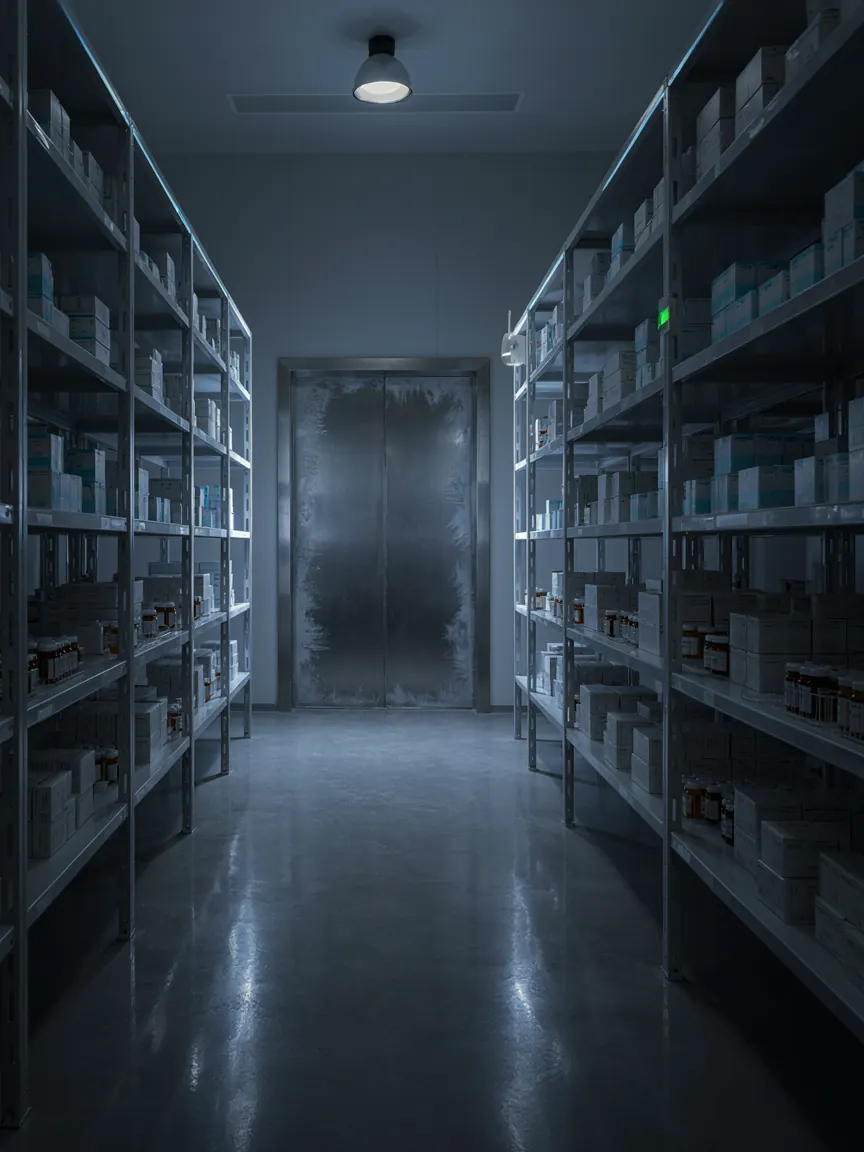
A cold room fails in two ways, and a dial gauge on the wall catches neither in time. The first is slow: a compressor loses capacity over days, the room still reaches set-point overnight but takes longer each day, until one hot afternoon it does not. The second is fast: a door is wedged open for a delivery, the room climbs several degrees in minutes, and the person who opened it has gone to lunch. A cold room temperature monitoring system is built to see both, alert the right person and keep the record. It is the most common installation HHET makes within a wider temperature and humidity monitoring system, from single pharmacy fridges to multi-room distribution cold stores across Saudi Arabia.
What a cold room monitoring system watches
Temperature is the obvious signal, but a useful cold room monitoring system records at least four. Air temperature at one or more points in the room. Door state, from a magnetic contact on each door, so every opening has a start and an end time. Power, so that the system knows a rise in temperature began with a supply interruption rather than a plant fault. And in many rooms, humidity, which affects frost build-up on evaporators and the condition of packaging. Each sensor reports to the HHET platform at an interval set for the room, typically every few minutes, and the platform draws the trend, applies the limits and manages the alarms. Staff see live readings on a wall display or in the HHET app; managers see every room on every site from one screen.
Sensor placement in chillers, freezers and blast cells
Where the probe sits decides what the system can see. In most installations HHET places one sensor at the warmest point of the room, usually high, away from the evaporator and near the door, because that is where product is at risk first; and one near the return air to the evaporator, which shows what the plant is doing. Larger rooms, or rooms with product stacked to the ceiling, add a sensor per zone. In freezers the sensing electronics stay outside the cold and only the probe enters, which protects battery life and accuracy. In blast cells, where product is pulled down quickly, a probe in a dummy product gives a truer picture than air temperature alone. For pharmacy and vaccine fridges, a probe in a liquid-filled buffer vial warms as slowly as the product itself, so a short door opening does not register as an excursion; the guide to vaccine storage temperature explains why that matters. A short mapping exercise before the sensors are fixed confirms the warmest and coldest points rather than assuming them.
Door events and the patterns of compressor failure
Door contacts turn a vague rise in temperature into an explained one. The platform shows each opening as a marker on the trend, so a quality manager can see that the room warmed because the door was open for eighteen minutes at 14:10, not because the plant failed. Repeated long openings at the same time each day point to a delivery routine that needs changing. Compressor problems leave a different signature. A healthy room cycles between its set-point and a few degrees above it in a regular saw-tooth. A compressor losing capacity shows a longer recovery after each door opening and a rising floor to the trend over several days. Iced evaporators show the same pattern until a defrost clears them. Because the HHET platform keeps the history, these patterns are visible weeks before the room finally fails, when a maintenance call costs little and stock is not at risk.
Room types and typical ranges
Ranges below are typical operating bands. Your product specification and, for medicines, SFDA expectations take precedence.
| Room type | Typical range | What usually goes wrong | Monitoring notes |
|---|---|---|---|
| Chiller and cold store | 0 °C to 5 °C | Door openings; loading warm product | Warmest-point sensor near the door; door contact; humidity optional |
| Freezer and frozen store | -18 °C or below | Defrost cycles masking plant decline; iced evaporators | External probe with electronics outside the room; alarm delay tuned to defrost |
| Blast chiller and blast freezer | Pull-down to target within a set time | Incomplete pull-down; product loaded too warm | Product-simulant probe; cycle-based alerts rather than fixed limits |
| Pharmacy and vaccine fridge | 2 °C to 8 °C | Door left ajar; items against the back wall freezing | Buffered probe; short interval; escalation to the pharmacist on duty; calibration certificate |
| Pharmaceutical cold room | 2 °C to 8 °C | Uneven distribution; warm zones near doors and lights | Mapping study; several sensors; records retained for inspection |
Alarm escalation at night and on weekends
Most cold-room losses happen when nobody is on site: overnight, on Fridays, during Eid. The alarm design has to assume that. HHET configures a cold room temperature alarm in stages. A delay of several minutes before the first alert, so a routine door opening does not trigger it. A first notification to the person on duty by app and SMS. If it is not acknowledged within a set window, a voice call to the supervisor; then to the manager; then, if you choose, to HHET support. Every step and acknowledgement is logged. Thresholds can differ by time of day, so a night-time alarm fires sooner because nobody will notice the door. The design of these chains is covered in more depth on the temperature alarm systems page. The aim is simple: the alarm reaches a person who can get to the room before the stock is lost.
Test the escalation chain on a Friday afternoon, not a Tuesday morning. If the second and third names do not answer when the first is unavailable, the chain is a list, not a safeguard. HHET runs this test at commissioning and recommends repeating it whenever staff change.
Power cuts: what the system does when the compressor stops
A power interruption stops the refrigeration plant, and on a badly specified system it stops the monitoring too, leaving a gap in the record exactly when the record matters. HHET specifies battery-backed gateways and battery-powered sensors so readings continue through the outage, and a power-loss alert goes out the moment supply drops rather than when the room has already warmed. The platform then shows how long the room held its temperature without power, which is useful information for deciding whether to move stock or wait for the generator. If the site's connectivity also fails, the gateway stores readings locally and uploads them when the link returns, so the record remains continuous. Generator changeover and UPS behaviour are tested at commissioning so there are no surprises on the first real cut.
Records, loggers and getting a quote
Every reading, alarm and acknowledgement is retained in the HHET platform and exportable as PDF or spreadsheet for food-safety inspections, SFDA visits, customer audits and insurance claims. Where product leaves the room for a journey, a portable temperature and humidity data logger continues the record in transit. Cold rooms inside a larger facility are usually monitored alongside the ambient areas; the warehouse temperature and humidity monitoring page covers mapping of the wider building. Price is driven by the number of rooms and doors, the sensor types (buffered, low-temperature or ambient), whether calibration certificates are required, and the escalation and reporting you need. To scope a cold room monitoring system for one site or many, request a quote with the number and type of rooms.
Kitchens and clinics use cold rooms differently. See HACCP temperature monitoring for restaurants and central kitchens, and hospital and laboratory monitoring for clinical refrigeration.
Last reviewed .