
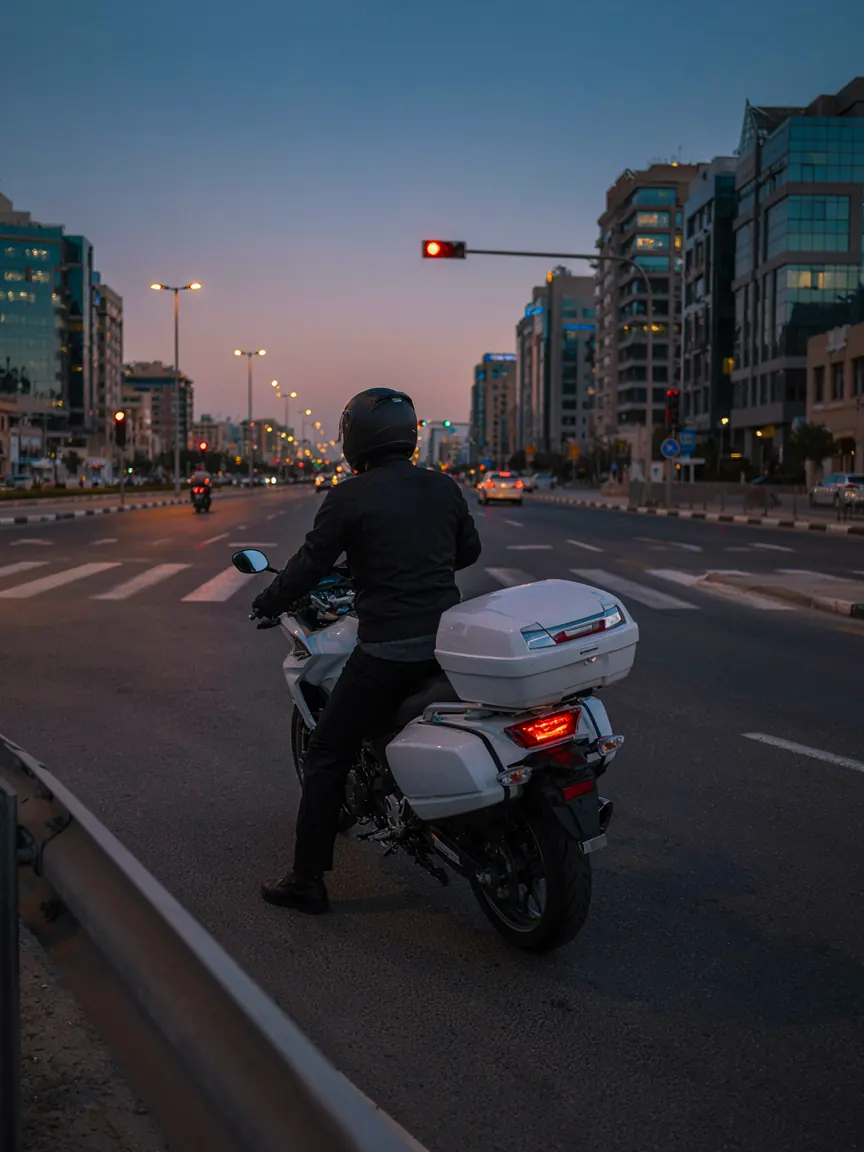
A motorcycle GPS tracker does the job of a car unit in a fraction of the space: it fixes its position from satellites, reads the ignition and speed, and sends them over the mobile network to a map you can open on a phone. It is one of the specialised devices in our range of car GPS trackers and tracking devices, adapted for the harder conditions on two wheels: vibration, rain, wash-downs, a tiny battery and almost nowhere to hide a box. HHET supplies and fits them for delivery companies and for businesses that run a few company motorcycles, across Saudi Arabia from our base in Jeddah.
Why delivery fleets track their bikes
A delivery bike is a small asset that does a lot of work with no supervisor beside it. Three problems come up again and again in bike fleets, and each one has a figure behind it that a tracker can supply.
Unproductive time. Dispatchers can see an order's status in the delivery app, but not where the rider is between orders. A tracker shows whether a bike is waiting at a restaurant, parked at a mall, or travelling, and for how long.
Personal use and extra kilometres. Company bikes get taken home, lent to friends and ridden on weekends. A trip report with start and end addresses and a distance total makes it easy to separate the shift from everything else, and a schedule alert flags movement outside working hours.
Theft. A motorcycle can be lifted into a pickup in seconds. A tracker that notices movement while the ignition is off gives you what a lock cannot: a trail to follow.
Compact, waterproof trackers for motorcycles
Bike units are small, usually the size of a matchbox or a pack of cards, and sealed against water and dust, typically to an IP65 or IP67 rating. They run on the bike's 12 V battery through a fused lead and draw very little current, so they do not drain a battery that is already small and often old.
The options differ from cars in one important way. Most motorcycles have no OBD port, so the plug-in route used for cars is rarely available, and the choice is between a wired unit and a battery-powered one.
| Option | Power | Best for | Reporting | Trade-off |
|---|---|---|---|---|
| Wired compact tracker | Bike battery, fused lead | Delivery fleets and daily-use company bikes | Every few seconds while moving, longer interval when parked | Needs a proper installation and a hiding place under the seat or fairing |
| Battery tracker | Internal rechargeable cell | Occasional-use bikes, a second hidden layer, quads and trail bikes | On a schedule you choose; life depends on how often it reports | Needs recharging; short intervals shorten battery life to days |
| OBD plug-in | Diagnostic port | Rare on bikes; some larger touring models only | As a car OBD unit | Not applicable to most delivery motorcycles |
For a working delivery fleet, the wired unit is the normal choice, because the bike is on the road all day and nobody wants to recharge forty trackers every few nights. Battery units earn their place as a second layer on a valuable bike or on machines that have no stable power.
Rider trips, speed and stops
The platform records every trip as a line on the map with start and end times, distance, maximum speed and the stops in between. For riders, three reports matter most. The trip report lists each journey so a manager can check a delivery claim against the actual route. The stop report shows how long the bike sat at each location, which separates a two-minute handover from a forty-minute coffee. The speed report records every time a bike exceeded the limit you set, with the place and time.
Speed is not only a safety matter. Speeding fines in Saudi Arabia, caught by Saher cameras, go to the registered owner of the vehicle, which for a company bike means the company. A speed alert and a weekly ranking of the fastest riders gives a manager something concrete to discuss before the fines add up. Harsh braking and acceleration events come from the tracker's accelerometer; see driver behaviour monitoring for how those scores are built.
Theft alerts and recovery
Theft alerts on a motorcycle rely on two inputs. The first is the ignition signal: if the bike moves while the ignition is off, the tracker treats it as movement without a key. The second is the built-in motion sensor, which wakes the unit when the bike is lifted, tilted or towed even though the engine never starts. Either one sends an alert to the manager by push notification or SMS with the current position, and the unit switches to frequent reporting so you can watch the route in real time.
Two practical points. First, a tracker finds a bike; it does not stop it. Recovery means giving the police an accurate position, plate and chassis number. Second, engine cut-off on a motorcycle needs care. Cutting the ignition on a bike at speed is dangerous, so where a relay is fitted at all it should only act when the bike is stationary or below a low speed. The full explanation of how that works sits on our page about anti-theft tracking with engine cut-off.
Delivery and ride-based transport in Saudi Arabia is overseen by the Transport General Authority (TGA), and some licensed activities must link their vehicle tracking to the WASL platform. Whether your delivery operation falls under that requirement depends on your licence and activity. Confirm with TGA, then tell HHET before ordering so we can confirm which devices suit it.
Installation on common delivery bikes
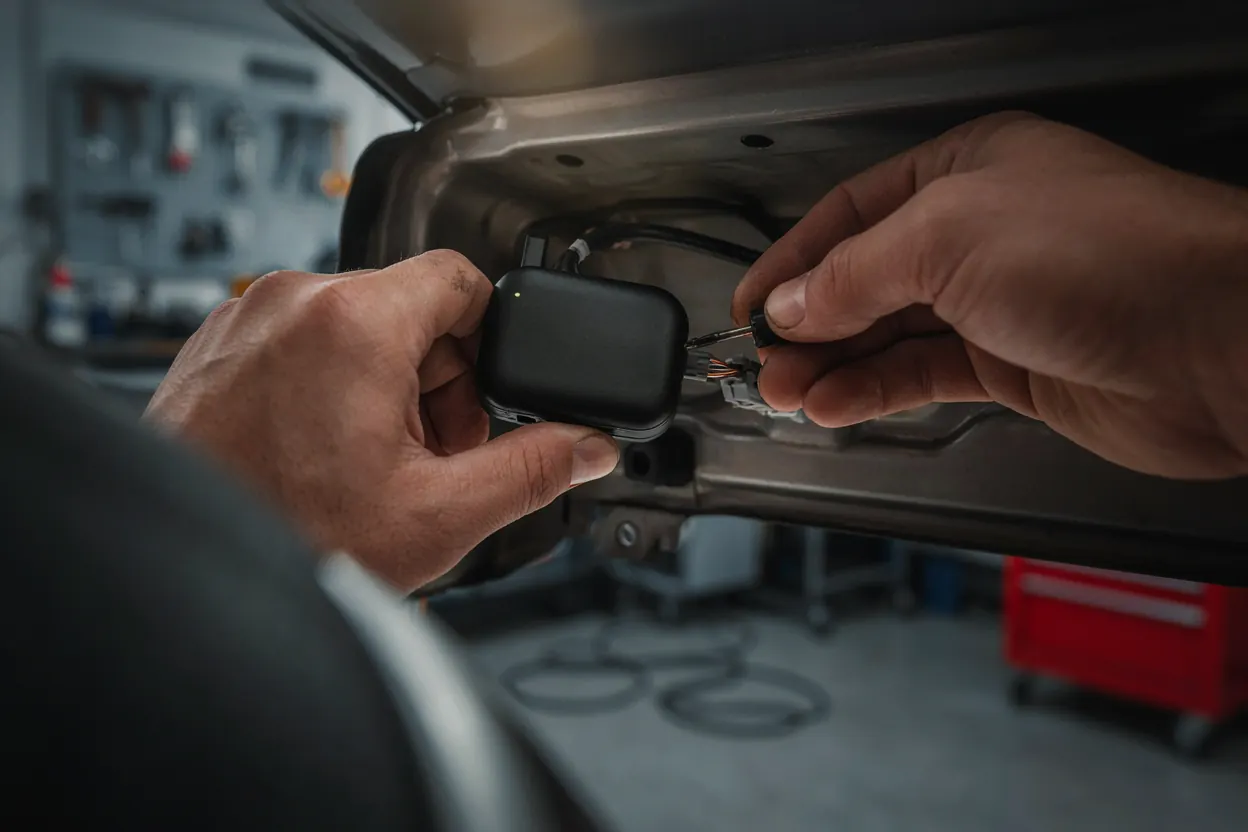
Most delivery fleets in Jeddah, Riyadh and Dammam run the same short list of small and mid-size commuter and cargo motorcycles, and that helps: the same installation can be repeated across the fleet. A technician removes the seat or a side fairing, fixes the tracker where it is shielded from rain and engine heat, and connects the fused power lead to the battery. The ignition wire is tapped from a switched circuit; on bikes with no clean switched feed, the tracker can infer ignition from battery voltage and motion instead.
Placement matters more than it looks. Under a black seat in a Jeddah summer, temperatures rise quickly, so the unit goes away from the exhaust and the engine, not directly under the seat pad. The antenna needs a clear view of the sky through plastic or fibreglass, never under metal. Our guide on where to place a GPS tracker lists what to avoid. Fitting a single bike usually takes well under an hour at our workshop or at your depot. For a fleet we work through the bikes in batches at your site, so riders lose as little shift time as possible.
Zones instead of phone calls
Draw a geofence around each branch and one around the zone a rider should cover, and the platform alerts you when a bike strays. The geofencing guide shows the rule patterns that suit delivery.
Running bikes inside a wider fleet
Delivery companies rarely run bikes alone. The HHET platform shows bikes, vans and cars on one map, and the fleet management system adds maintenance reminders by distance, which suits bikes that rack up kilometres quickly and need oil and chain service often. If you operate a delivery business as a whole, our overview of delivery and e-commerce fleet tracking shows how bikes, vans and customer-facing reports fit together.
What decides the price
The cost per bike depends on whether you choose a wired or battery unit, the number of bikes, whether installation happens at your depot or our workshop, and the subscription plan that covers the SIM data and platform access. HHET prices per fleet. Request a quote with the number of bikes, the models and the cities you ride in, and we will propose a unit, an installation plan and a monthly line you can budget against.
Last reviewed .