
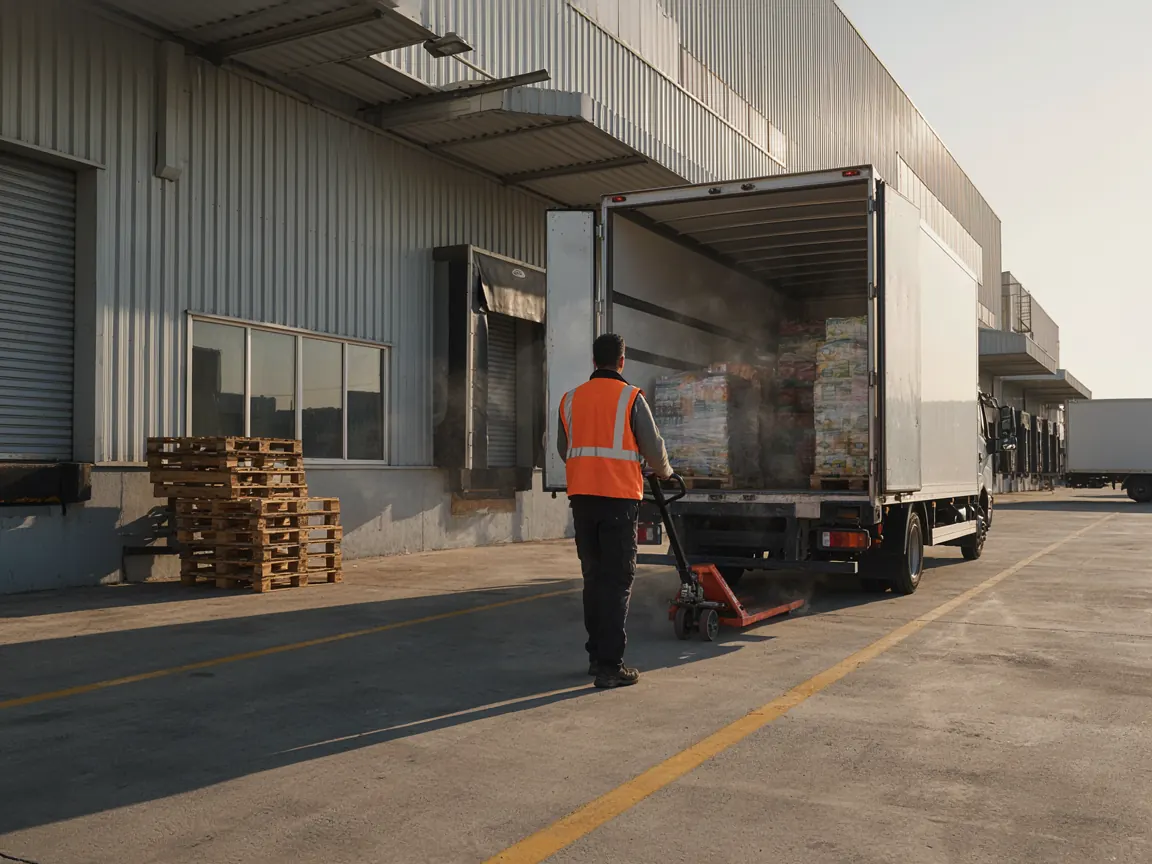
A food distributor's cold chain is only as strong as its last forty minutes: the van that sits in Jeddah traffic at 41 °C with the rear door opening every few stops. Food delivery temperature monitoring puts a sensor in that van, reads it continuously and tells the dispatcher before the customer's thermometer does. This page is for caterers, central kitchens and chilled or frozen food distributors. It describes how they combine HHET's temperature and humidity monitoring with vehicle GPS, so the van, the product and the record travel together. Other sectors are listed on the industries overview.
Chilled and frozen delivery in Saudi heat
Refrigerated delivery in the Kingdom works against the climate. Ambient temperatures in summer push a van's refrigeration unit hard, a door opened at a loading bay lets heat in faster than the unit can recover, and the pattern of many short drops, each with a door opening, is more demanding than one long haul. Frozen product at -18 °C and chilled product at 0 to 5 °C, depending on the item, do not forgive a long recovery.
The common failure points are specific, and each leaves a trace if you are recording:
- A body loaded warm. The unit was switched on late, so the first drops are made from a van that never reached temperature.
- Doors open too long at a drop. A single kitchen delivery with a long hand-over adds up across forty stops.
- Mixed loads. Frozen and chilled in one body with one set-point, which suits only one of them.
- The unit off at a stop. The driver stops the engine for a meal while the cold stays in, until it does not.
Refrigerated van and truck monitoring
Refrigerated van tracking adds to ordinary GPS the three things a food business actually needs: where the van is, what the load is experiencing and what happened at each door opening. The unit in the cab reads one or more probes in the cargo area, a door contact on each opening and, where the refrigeration controller supports it, set-point and unit status. The dispatcher's map shows each van with its temperature colour-coded against limits. The mechanics are in refrigerated truck monitoring; for trucks and vans that must also report for licensing, the driving and route side is covered on truck tracking.
| Delivery problem | What the sensors catch | What the dispatcher does |
|---|---|---|
| Body not pre-cooled before loading | Temperature above range at the first door close | Hold the van at the dock until the body is back in range |
| Slow deliveries with doors open | Door-open duration per stop, against a planned time | Coach the driver; review route order and drop-off procedure |
| Frozen and chilled in one body | Two probes show one zone drifting while the other is fine | Split loads or add a divider and second zone |
| Unit off while parked | Engine off, cargo loaded, temperature rising | Alert the driver to restart; log the interval |
| Heat plus traffic on a long run | Temperature trending up with the van static | Call ahead to the customer; reroute the next drop |
Food temperature monitoring devices come in two forms on a van: fixed probes wired to the tracker for the permanent record, and handheld probe thermometers for spot checks at the dock. HHET specifies the fixed system; handheld checks stay a human procedure and can be noted on the delivery record. For loads handed to a subcontractor with no HHET unit, a small data logger in the cargo gives a record for that leg. The guide on choosing a data logger covers when this is enough.

The central kitchen and the van as one chain
Caterers and central kitchens have a particular difficulty: the product leaves a monitored kitchen, enters a van, and is served at an event or a branch that has its own fridge. Each hand-over is a place where the record can break. The practical approach is to treat the chain as three segments, kitchen cold room, van and receiving point, and to give each a sensor reporting to the same platform with the same limits. When a customer later claims that a delivery arrived warm, the three records show where the temperature rose, or that it did not. This is the same logic used in cold chain monitoring for larger distributors, scaled down to a catering operation with a handful of vans.
Event catering adds a twist: vans stand at the venue for hours with the engine off. A battery-backed sensor in the cargo area keeps reporting there, so the record covers service time as well as the drive.
HACCP records without paperwork
Food businesses in Saudi Arabia work under HACCP-based food safety systems, and the temperature log is among the first documents an inspector or a customer's auditor asks for. On paper, the log depends on the driver remembering to write it, and on nobody correcting the number afterwards. A continuous electronic record removes both weaknesses.
Food safety inspection in Saudi Arabia is carried out by authorities including SFDA and the municipality, depending on the activity. Requirements for temperature records vary with the business licence and product. HHET provides the continuous record and the report format; your quality manager remains responsible for the HACCP plan, and we check current requirements for your activity before setup.
The HHET platform timestamps each reading, stores it with the vehicle and location, and raises a corrective-action entry when a limit is crossed, which the supervisor completes in the system. At the end of the month the log, the exceptions and the actions can be exported as one report. The same approach applies to the kitchen or store behind the van, as covered in food HACCP monitoring, so the storage log and the delivery log use one format. For a short explanation of what an inspector looks for, the guide to HACCP temperature logging is a good starting point.
Set different alert delays for frozen and chilled zones. A frozen zone may tolerate a short rise while a door is open; a chilled dairy compartment may not. One delay for the whole van produces either false alarms or missed ones.
Recommended HHET solutions
The right set-up follows the delivery pattern, not the vehicle badge.
| Fleet type | Recommended set-up |
|---|---|
| Small refrigerated vans on multi-drop urban routes | Compact tracker with one cargo probe, rear door contact, driver alerts for door-open time |
| Multi-compartment trucks for chilled and frozen | Probes per compartment, door contacts, set-point comparison where the reefer allows |
| Central kitchen with outbound catering vans | Vehicle units plus wireless sensors in kitchen cold rooms, one platform and one report |
| Subcontracted legs | Portable data logger sent with the load and read on return |
Price depends on the number of vehicles and compartments, probe count and calibration, door sensors, any controller link and the subscription. To plan a rollout, request a quote with your vehicle list, route pattern and product temperatures.
Last reviewed .