

A haulage company in Saudi Arabia does not lose money in one dramatic event. It loses it in a driver who idles for forty minutes at a customer gate, a truck that takes the longer road, a trailer that sits unseen at a depot, and a customer who phones asking where the load is while dispatch rings three drivers. Company truck tracking exists to remove those quiet losses. This page describes how logistics and transport firms use HHET's vehicle tracking system across mixed fleets, and where the truck tracking service fits. Other sectors served are listed on the industries overview.
The pressures on Saudi logistics fleets
The work is long distance and high volume: Jeddah Islamic Port to Riyadh dry ports, Riyadh to Dammam, and the daily distribution runs that feed them. That puts four pressures on a fleet manager at once.
- Distance without visibility. On a ten-hour leg through open country, a phone call is the only check, and drivers learn when nobody is looking.
- Heat and idling. In summer, drivers leave engines running for air conditioning during waits. Over a month, across forty trucks, that is a fuel line item that nobody sees on the invoice.
- Mixed assets. Prime movers, rigid trucks, tippers, tankers and trailers that change tractors. The record has to follow the trailer, not just the truck.
- Customers who want answers now. A shipper asks for an arrival time, not an apology.
A commercial fleet tracking setup answers these with data the dispatcher already has open: position, ignition, speed, stops and fuel on one map. The question is not whether to track, but how much of the operation the data should cover.
WASL compliance across the whole fleet
For goods-transport operators, vehicle tracking is also a licensing matter. The Transport General Authority (TGA) links licensed transport activity to the WASL platform, and vehicles in covered activities typically need an approved tracking device integrated with it. In a fleet of a few vehicles this is a one-time task. In a fleet with trucks being added, sold and reassigned, it becomes a register that has to stay correct.
Whether a given vehicle or activity must report to WASL, and which integration route applies, depends on the licence and vehicle class. HHET checks the current TGA requirement against your licence before specifying devices, and confirms integration status vehicle by vehicle rather than assuming it. Full detail is on the page about TGA and WASL vehicle tracking.
What helps a logistics company is one place that shows every vehicle, its device status and its integration state, so a truck added in Dammam does not run unreported for a month. Fitting new vehicles with the same unit type as the rest of the fleet, and keeping device and plate details in the platform, makes the register something dispatch maintains daily rather than something compliance rebuilds before a renewal.
Fuel, idling and route control
Fuel is typically the largest controllable cost in a trucking operation, and the controls are simple once the data exists. Ignition-on with speed zero shows idling, per truck and per stop. A route geofence flags a vehicle that leaves its planned corridor. Speed events show where a driver runs hard, which also tells you where tyres and brakes go early. Where the truck has a fuel sensor, the platform records level through the trip, which exposes both a slow leak and a sudden drop at an unscheduled stop; the page on fuel monitoring describes how the sensors are fitted and calibrated.
The numbers become useful when you compare like with like. Two trucks on the same Jeddah to Riyadh run, carrying similar loads, should burn similar fuel. When one does not, the platform shows the difference in idle minutes, speed profile and stops, which is a conversation with the driver based on a record, not a suspicion. Over a quarter, the same data sets a realistic idle limit and a fair benchmark by route.
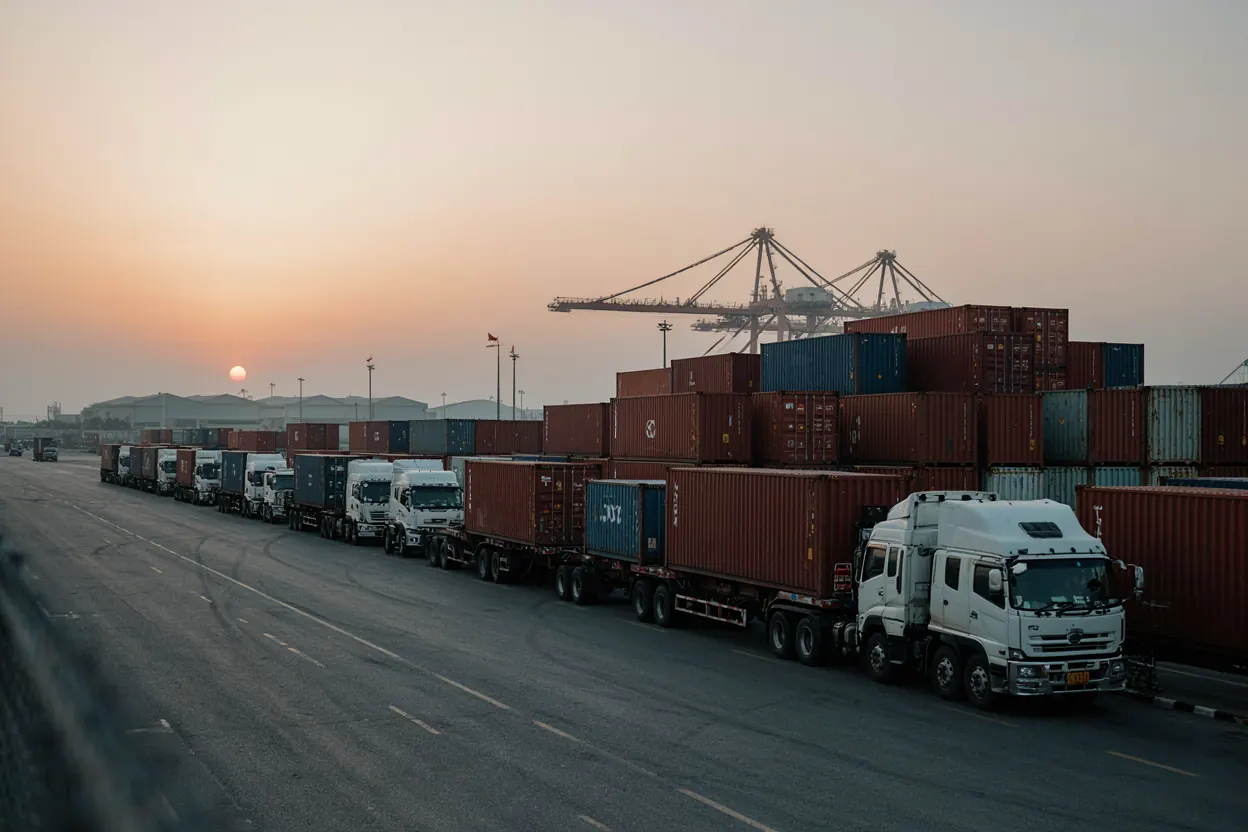
Proof of delivery and customer visibility
A logistics fleet is paid on delivery. Geofences on each customer site, depot and port gate produce arrival and departure stamps automatically, so a dwell dispute is settled by a timeline, not by memory. The trip report shows when the vehicle entered the site, how long it stood, when it left and what route it took. That is the evidence behind a detention charge, or behind a rebuttal of a late-delivery claim.
For customers, the same data can be shared as a tracking link or a scheduled report, so a shipper sees the truck's progress without calling. Dispatchers also gain from reading the whole fleet as a logistics fleet management system rather than as dots: planned versus actual arrival, trips per vehicle, and a daily summary of exceptions. The wider tooling for this is described under fleet management system, and the guide to how geofencing works explains the zones that make arrival stamps reliable.
Draw geofences around the gate queue as well as the yard. Then you can see how long trucks wait outside before the clock your customer recognises even starts.
What changes in the dispatcher's day
The first change is the morning. Instead of ringing drivers, the dispatcher opens one list: vehicles not yet moved, vehicles outside their corridor, vehicles idling beyond the limit, trailers parked without a tractor. The second change is the afternoon call from a customer, which is answered from the map in under a minute. The third is month-end, when trip counts, kilometres and idle hours per truck arrive as a scheduled report instead of being assembled from driver sheets. None of this needs a larger office. It needs the same people to stop chasing information and start deciding on it. A fleet of ten trucks and a fleet of two hundred use the same screens; the difference is how many exception rules you set, and who receives them.
Driver behaviour is part of this, and it is best handled as coaching. Harsh braking, speeding on the Makkah road and night driving beyond permitted hours appear per driver. The page on driver monitoring explains the scoring, and how to share it with drivers so that it is understood as fairness rather than surveillance.
Recommended HHET solutions
Logistics fleets are rarely uniform, so the build is by vehicle role.
| Vehicle or need | Typical HHET set-up | Why |
|---|---|---|
| Prime movers and rigid trucks on long hauls | Wired tracker with ignition, speed and optional fuel input; WASL-ready where the activity needs it | Continuous position on long legs, idle and fuel control |
| Trailers swapped between tractors | Battery-powered trailer unit with movement and door alerts | Record stays with the trailer, not the truck |
| Tippers and site-bound trucks | Wired tracker with engine-hours and geofenced sites | Billing by trips and hours, after-hours movement |
| Reefer loads in the fleet | Cargo probes and door sensors on the same unit | Temperature joins position on one map |
| Dispatch and back office | HHET platform and app, reports scheduled by email | One view across depots in Jeddah, Riyadh and Dammam |
Where trucks carry temperature-controlled loads for part of the year, the same platform covers them; see refrigerated truck monitoring. Price depends on vehicle count, device types, fuel sensors, WASL work, installation locations and the subscription. To scope your fleet, request a quote with your vehicle types and routes.
Last reviewed .