

An OBD GPS tracker plugs into the diagnostic socket that almost every modern car carries under the dashboard, and starts reporting the moment it is seated. There is nothing to cut, splice or hide behind a panel. It is the quickest member of our range of car GPS trackers, which makes it a sensible choice for sales cars, pool vehicles and light vans that change hands, and an honest compromise where a hard-wired install is not practical. This page explains what the device reads, where it works well, and the places where a wired unit is the better answer.
What an OBD tracker is
The OBD-II port is a 16-pin connector standardised across passenger cars and light vans, and used by workshops to read fault codes. A tracker built for it carries a GPS receiver, a 4G modem with a SIM, a small motion sensor and a connector that takes power from pin 16 and ground from the port. On many cars it also listens to the vehicle's data bus on the same connector. Position goes up to the HHET platform over the mobile network, and the platform displays it on the live map next to the rest of your vehicles.
Because it draws power from the car, it does not need charging. When the engine is off it drops into a low-power sleep and wakes on movement or ignition. That sleep mode matters: a poorly designed plug-in unit can pull a flat battery on a car that sits for a week, which is why HHET checks the sleep current of any unit it supplies.
Install in minutes, no wiring
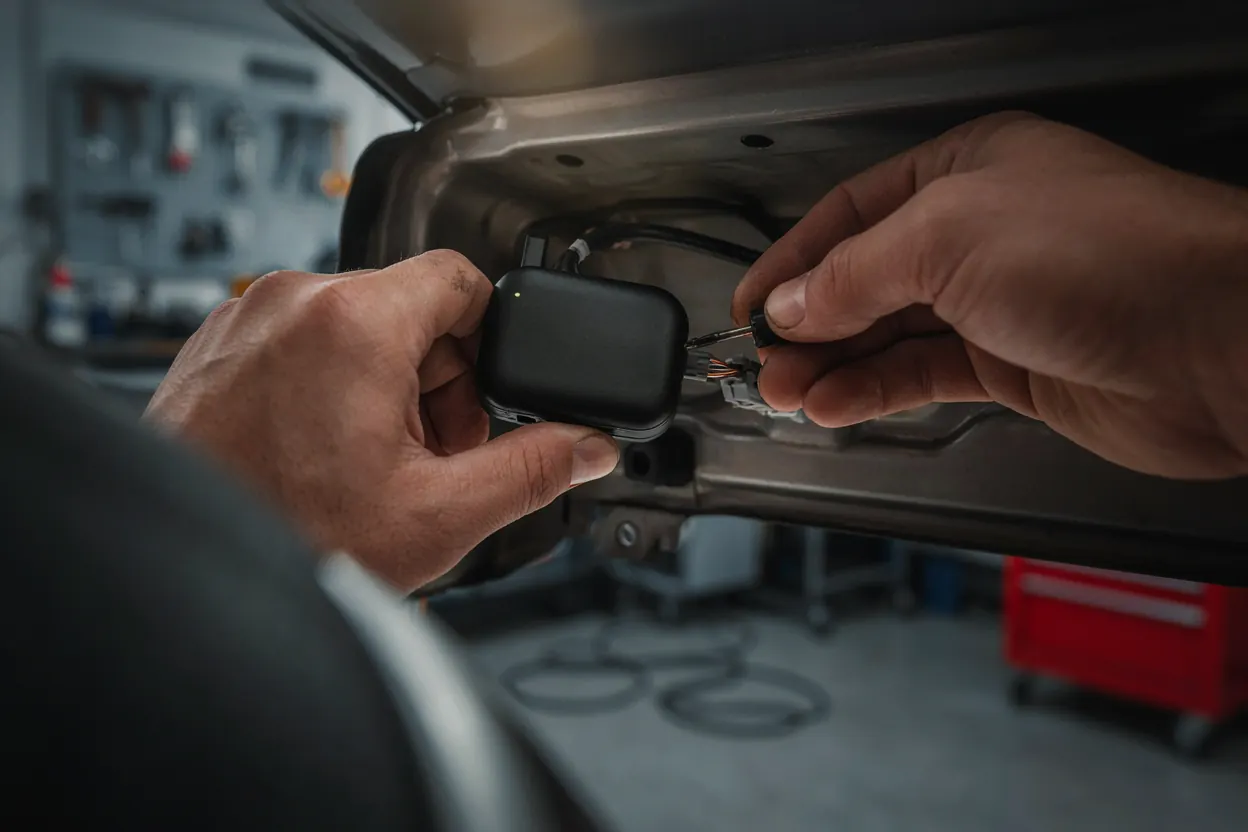
Installation is the main reason fleets choose OBD. The port is usually under the steering column on the driver's side, a few centimetres above the knee, and the tracker clicks in. Our technician or your own staff can do it in a couple of minutes, and the vehicle is on the map before the engine has been switched off. There is no downtime and no change to the vehicle's wiring, which makes OBD attractive for leased vehicles that must be returned unmodified. It also suits businesses that rotate cars between staff, since a unit can move to another vehicle in the same time.
If you want the wired approach for comparison, our GPS tracker installation service page covers what a hidden installation involves, and the how-to on installing a GPS tracker in a car shows the steps for each type.
Engine data and driving scores
Because the unit sits on the car's diagnostic connector, it can read more than position. What it actually reports depends on the car and the model of tracker, so treat the list below as typical, not guaranteed for every vehicle.
- Ignition, speed and distance from the vehicle itself, which are more accurate than GPS alone at low speed.
- Engine speed and coolant temperature, useful for spotting vehicles that are run hard or overheating in Jeddah summers.
- Battery voltage, which warns of a weak battery before the car fails to start.
- Diagnostic fault codes, reported to the platform so a check-engine light becomes a maintenance ticket.
- Fuel level, on vehicles that expose it. Accuracy is lower than a calibrated tank sensor, and our fuel monitoring page explains when a dedicated sensor is worth fitting.
The tracker's accelerometer adds harsh braking, harsh acceleration and cornering events. The platform turns these and overspeed alerts into a driving score per driver. Scores are best read as a conversation starter and a trend, not a verdict on one trip.
When to choose OBD over wired
| Question | OBD plug-in | Wired tracker |
|---|---|---|
| Install time | Minutes, no tools | One to a few hours, panel removal |
| Can be unplugged by a driver | Yes; platform alerts you when it happens | Not without removing trim panels |
| Moves between vehicles | Yes | No, reinstall needed |
| Engine cut-off relay, fuel probe, driver ID reader | Generally not | Yes |
| Trucks, buses, heavy equipment | Not suited; they use different connectors and 24 V | Yes |
| Leased or short-term vehicles | Ideal; leaves no trace | Needs removal on return |
Choose OBD for cars and light vans where speed of deployment, easy transfer and clean return matter more than concealment. Choose wired where the vehicle needs a relay, sensors or a driver reader, where theft protection is the main reason for tracking, or where the vehicle is a truck. A mixed fleet is common, and the HHET platform treats both kinds of unit the same way on one map. The wider comparison, including battery units, is in our guide to GPS tracker types.
The weak points, stated plainly
An OBD tracker is visible to anyone who looks under the dash. A driver who knows the port can unplug it, and a thief who knows the port will. The platform alerts on removal, using a last-gasp message sent as power is lost, and a dedicated retaining clip or cable-tie on the connector slows casual removal, but neither makes the device invisible. For high-value vehicles, tracking is better done with a wired unit; see our page on anti-theft tracking with engine cut-off.
There are other limits. Some newer vehicles fit a security gateway that restricts what a third-party device can read from the port, so you get position but little engine data. Workshops need the port during servicing, and the unit may be removed and not refitted; list it in your service checklist. And the port power stays live on some cars with the ignition off, which is why sleep current is important.
Where your activity is licensed by the Transport General Authority (TGA), for example taxi, rental or freight, tracking devices typically must be approved and linked to the WASL platform. A plug-in unit that can be removed by the driver may not be accepted for that purpose. Confirm the requirement for your licence before choosing OBD, and ask HHET to check the device against it.
Compatible vehicles
OBD-II compliance is the starting point. In practice, any petrol car built after roughly 2001 and most diesels built after the mid-2000s have the port, which covers the sedans, SUVs and pickups common on Saudi roads. Fit and signal quality vary by model, so HHET checks the exact make, model and year before supplying units for a fleet, and tests one vehicle first. Electric and hybrid vehicles often work for location but may report limited engine data. Heavy trucks and buses use a different diagnostic standard and 24 V power, and need a wired unit. For those, see our page on truck tracking.
The units themselves are 4G-capable, so they keep reporting where older 2G networks have been retired. They are no larger than a matchbox, so check with HHET that the unit leaves your knee room and does not touch the pedals.
What decides the price
Cost depends on the number of vehicles, the model of tracker (basic location units cost less than ones that read full engine data), the subscription term covering the SIM and platform, and whether you want HHET to fit and test each unit. Request a quote with your list of makes, models and years and HHET will confirm compatibility vehicle by vehicle.
Last reviewed .