

A GPS tracker for a trailer reports where the trailer is even when it is parked, detached from its tractor, and has no vehicle power. That is the whole difference from tracking a truck: the trailer has no engine, no ignition and often no electrical supply beyond lights, so the tracker has to carry its own power. It is a special case of the vehicle tracking system, and HHET supplies, fits and supports trailer and container tracking from Jeddah for operators across Saudi Arabia.
Tracking assets that have no power
A truck tracker draws on the vehicle's 24 V supply and wakes when the ignition turns. A trailer tracker has none of that. Trailers sit for days in yards at Jeddah Islamic Port, in Dammam's industrial areas, or at roadside depots, and they are the target when thieves want cargo or a chassis. If the trailer is only tracked when the tractor is attached, its position is unknown for most of its life.
The solution is a tracker designed for low power: it sleeps most of the time, wakes on motion or on a schedule, reports its position and goes back to sleep. A unit built this way typically reports once or a few times per day while the trailer is stationary and every minute or so while it moves. The trade-off between reporting frequency and battery life is the main design decision, and HHET sets it per use case.
Battery and solar trackers for trailers
There are three ways to power a trailer tracker, and each has a place.
- Battery-only tracker. A sealed unit with a large primary or rechargeable battery, magnet or bolt-mounted. Battery life ranges from months to a few years depending on the reporting interval and temperature. It suits containers and trailers that move rarely.
- Solar-assisted tracker. A small panel on the roof or side trickle-charges the battery. In the Kingdom's sun this keeps a unit alive indefinitely at normal reporting rates, with the battery carrying it through dust storms, covered yards and nights.
- Hardwired to the trailer supply. Connected to the 7-pin or 15-pin connector or the lighting circuit, with a backup battery. Gives continuous power but only while the tractor is attached, so the backup battery must still hold the detached state.
| Power option | Reporting while parked | Reporting while moving | Maintenance | Best for |
|---|---|---|---|---|
| Battery only | Once to a few times a day | Every 1 to 5 minutes, which shortens battery life | Replace or recharge on schedule | Containers, low-use trailers |
| Solar-assisted | Several times a day | Every minute or so | Clean the panel; periodic checks | Trailers parked outdoors in open yards |
| Hardwired + backup | Backup battery, set low | Continuous when attached | Check cable and connector | Trailers in daily service with the same tractor |
Desert heat matters here. Batteries lose life at sustained high temperature, and a dark trailer roof in August can run far hotter than the air. HHET specifies units rated for the temperature range and mounts them out of direct sun on the roof where possible. For tractor-side devices on the same fleet, the sizing and wiring are covered in GPS tracking for trucks.
Container tracking from port to warehouse
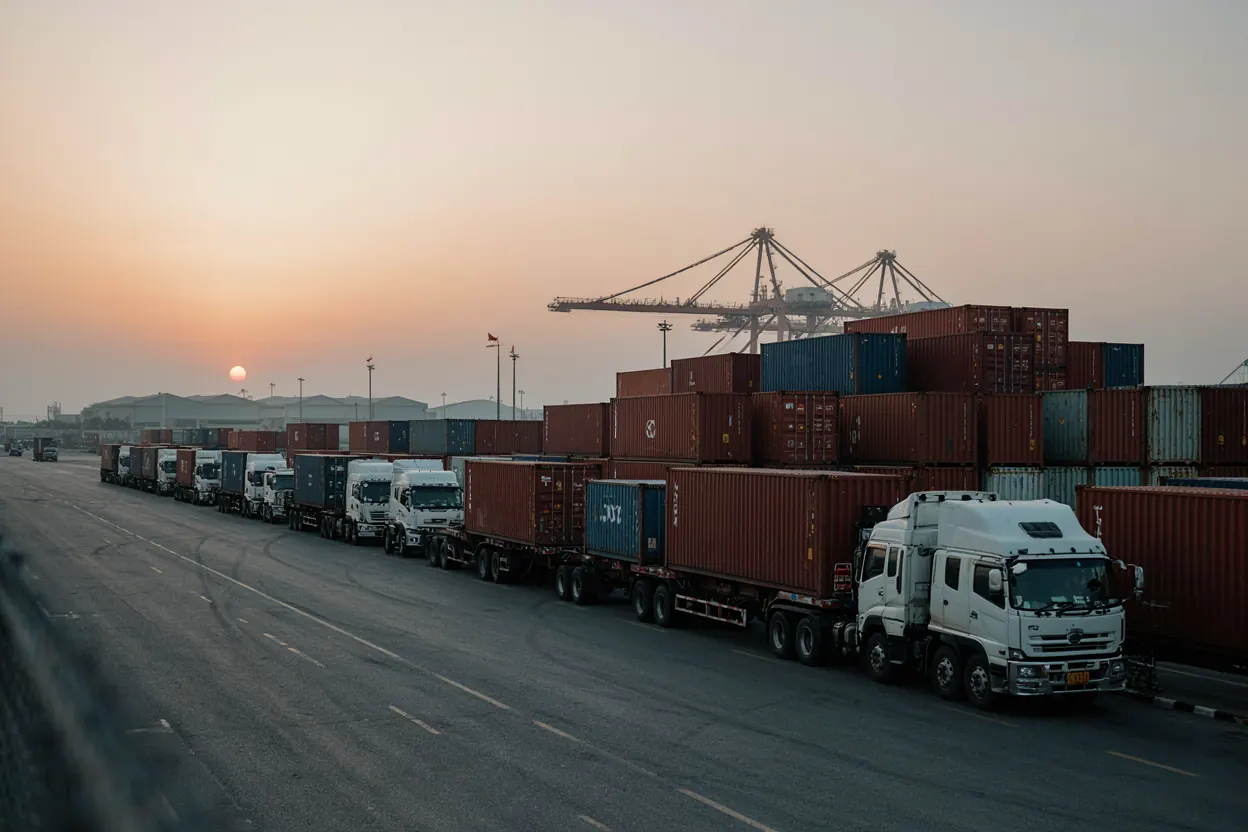
Container tracking follows a box through several hands: vessel, terminal, trucker, warehouse, return depot. A tracker on the container, or on the chassis carrying it, adds the leg between the terminal gate and the warehouse door, which is where delays and losses concentrate. A typical import run from Jeddah Islamic Port to a Riyadh warehouse is in the order of 950 km, and the platform shows a geofence on the terminal gate, an alert on departure, a transit log with stops, and an arrival alert at the warehouse. The same geofences show how long the box waited at the gate, and how long the empty container took to return afterwards, since detention and demurrage charges are a significant cost for importers.
Containers are steel boxes, so a tracker inside will not get a signal. HHET mounts tracker units externally on the container door frame or inside a recessed corner casting, or on the trailer chassis, in a position that keeps the antenna exposed. Door-open sensors, where supported, add an alert if the doors open outside a geofence. If your containers move across borders or need seals checked, ask during the survey, since the options differ by unit.
Coupling and detachment alerts
The moment of attach or detach is where trailers go missing. When the tractor is coupled, the trailer tracker sees external power and, if fitted, the coupling sensor; when it is uncoupled, the tracker records a detachment with time and position. The platform can then raise an alert when a trailer is detached outside an approved yard, which is the usual sign of a theft or a driver dropping a load at an unplanned location. A trailer that moves while no tractor of yours is paired is flagged too, as movement while unpaired is the signature of someone towing it away.
The alert includes a map position, the last paired tractor and a trail, so the control room can start recovery and report to the police with details rather than a hunch.
Pairing trailers with trucks
Most fleets rotate trailers across tractors, so the platform needs to know which trailer is behind which truck. HHET supports two methods. The first is automatic: a hardwired connection or an RFID tag at the fifth wheel reports the trailer ID to the tractor's tracker. The second is by proximity and time, where the platform infers the pairing when both devices move together from the same point. The result is a trip report that follows the trailer rather than the tractor, so a delivery that took two tractors still reads as one job. Pairing also lets you check that the right trailer is behind the right truck before a job leaves, and it connects to fuel and driver data in the fleet management system.
Freight activities licensed by the Transport General Authority (TGA) are typically required to link the tractor's tracking device to the WASL platform. Whether a trailer needs its own linked device depends on the activity and on the rules in force, so confirm with TGA what your licence requires. The linking process is set out in our guide to TGA-approved tracking and WASL integration.
Choosing and pricing a trailer tracker
For help picking a unit, the guide to GPS tracker types compares wired, OBD and battery devices. The cost of a trailer or container tracker depends on the power option, the reporting interval you want, the number of trailers, whether coupling sensors are included, and the subscription. Request a quote with your trailer and container counts and how long they typically sit unattended, and HHET will recommend a unit and reporting plan.
Last reviewed .